Smart Ring vs. Smartwatch: Choosing Your Perfect Wearable Companion
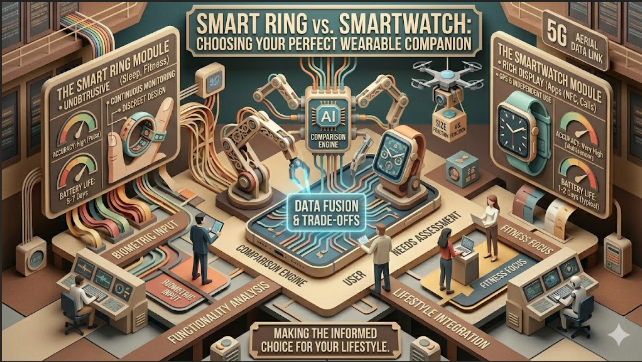
Smart Ring vs. Smartwatch: Choosing Your Perfect Wearable Companion
The world of wearable technology offers an exciting array of devices designed to enhance our daily lives, from tracking our health to keeping us connected. Among the most popular contenders are smartwatches and the burgeoning category of smart rings. While both aim to integrate technology seamlessly with our bodies, they do so with fundamentally different philosophies and feature sets. Deciding between a smart ring and a smartwatch isn’t a matter of which is objectively ‘better,’ but rather which aligns more closely with your lifestyle, priorities, and personal aesthetic. This detailed comparison will help you navigate their strengths and weaknesses, guiding you towards the wearable that’s right for your connected life.
Smartwatches: The Established All-Rounder
Smartwatches have been a staple in the wearable market for over a decade, evolving into sophisticated devices capable of a vast range of functions. Brands like Apple Watch, Samsung Galaxy Watch, and Fitbit dominate this space, offering a comprehensive suite of features.
Key Features and Benefits of Smartwatches
- Comprehensive Notifications & Communication: Receive texts, calls, emails, and app alerts directly on your wrist. Many allow for quick replies or even full conversations without needing your phone.
- Extensive Health & Fitness Tracking: Advanced sensors monitor heart rate, blood oxygen (SpO2), ECG, sleep patterns, steps, calories burned, and a wide variety of workouts. Integrated GPS tracks runs and rides with precision.
- On-Wrist Payments: NFC technology enables contactless payments via services like Apple Pay or Google Pay, making quick transactions effortless.
- App Ecosystem: Access a rich library of third-party apps for navigation, music control, productivity, and more, significantly extending functionality.
- Larger Display: The touchscreen display provides an interactive interface, allowing for easy data viewing, app interaction, and customizable watch faces.
- Safety Features: Many include fall detection, emergency SOS calling, and international emergency calls.
Drawbacks of Smartwatches
- Battery Life: Most smartwatches require daily or bi-daily charging, which can be inconvenient.
- Bulkiness & Design: While designs have improved, smartwatches can still feel bulky or conspicuous on smaller wrists.
- Distraction Factor: Constant notifications on your wrist can sometimes lead to information overload and distraction.
- Cost: High-end smartwatches can be a significant investment.
Smart Rings: The Discreet Innovator
Smart rings represent a newer, more minimalist approach to wearable technology. Gaining traction with products like the Oura Ring and Ultrahuman Ring AIR, these devices prioritize discretion, comfort, and extended battery life, often focusing heavily on health and wellness tracking.
Key Features and Benefits of Smart Rings
- Discreet Design & Comfort: Designed to blend in as a piece of jewelry, smart rings are lightweight, unobtrusive, and comfortable for 24/7 wear, including during sleep.
- Extended Battery Life: Due to their simpler functionality and lack of a power-hungry display, smart rings typically offer 4-7 days of battery life on a single charge.
- Advanced Health & Sleep Tracking: Many smart rings excel in passive, continuous monitoring of vital signs, offering highly accurate sleep stage analysis, heart rate variability (HRV), body temperature, and activity levels.
- Minimalist Interaction: Without a screen, interaction is usually limited to app-based data review on your smartphone, reducing digital distractions.
- Durability: Often built with robust materials and water resistance, they are designed for continuous wear in various environments.
Drawbacks of Smart Rings
- Limited Functionality: Smart rings generally lack the comprehensive features of smartwatches. No display means no on-wrist notifications, calls, or app interactions.
- No GPS or NFC Payments (mostly): Integrated GPS is rare, relying on a connected phone for location tracking. While some emerging rings offer NFC payments, it’s not a standard feature.
- Dependence on Smartphone: All data viewing and most settings adjustments require a companion smartphone app.
- Nascent Ecosystem: The smart ring market is less mature, meaning fewer choices and less third-party app integration compared to smartwatches.
- Sizing Challenges: Proper sizing is crucial for accurate tracking, and online purchases can sometimes lead to trial-and-error.
Smart Ring vs. Smartwatch: A Direct Comparison
| Feature | Smartwatch (e.g., Apple Watch, Galaxy Watch) | Smart Ring (e.g., Oura Ring, Ultrahuman Ring) |
|---|---|---|
| Display & Interaction | Full-color touchscreen, on-wrist interaction, customizable watch faces | No display, interaction via smartphone app |
| Notifications & Calls | Comprehensive on-wrist alerts, call answering/making, quick replies | Minimal to no on-ring notifications; relies on phone |
| Health & Fitness | Extensive, active tracking (HR, SpO2, ECG, GPS, workout modes, sleep stages) | Passive, continuous tracking (HR, HRV, temperature, sleep stages, activity) |
| Payments (NFC) | Commonly integrated (Apple Pay, Google Pay) | Rare, but emerging in some models |
| Battery Life | Typically 1-2 days (daily or bi-daily charging) | Typically 4-7 days (weekly charging) |
| App Ecosystem | Vast library of third-party apps | Limited, primarily focused on health data, fewer integrations |
| Design & Comfort | More conspicuous, can be bulky, worn on wrist | Discreet, lightweight, worn on finger, often feels like regular jewelry |
| GPS | Often integrated for standalone tracking | Relies on connected smartphone’s GPS |
| Price Range | Mid-range to premium ($200 – $800+) | Mid-range to premium ($250 – $400+) |
Choosing Your Ideal Wearable: Key Considerations
The right choice hinges on what you value most in a wearable device.
Opt for a Smartwatch if You:
- Need constant connectivity: You want to manage calls, texts, and notifications without constantly reaching for your phone.
- Desire comprehensive fitness tracking: You need detailed GPS tracking for runs, a variety of workout modes, and extensive real-time data during exercise.
- Appreciate versatility: You want access to a wide range of apps for navigation, music, productivity, and more directly from your wrist.
- Value convenience features: On-wrist payments, emergency features, and a bright, interactive display are important to you.
- Don’t mind daily charging.
Consider a Smart Ring if You:
- Prioritize discretion and aesthetics: You prefer a device that blends seamlessly with your personal style and doesn’t draw attention.
- Seek in-depth health and sleep insights: Your primary focus is on understanding your body’s recovery, sleep quality, and overall well-being with minimal interruption.
- Want excellent battery life: You prefer charging less frequently and want a device that can be worn continuously.
- Prefer a minimalist approach: You want health data without the distraction of a screen or constant notifications.
- Are comfortable viewing data primarily on your phone.
The Future of Wearables
The lines between smart rings and smartwatches may blur further as technology evolves. We might see smart rings incorporate more subtle interaction methods or smartwatches becoming even more streamlined. The emergence of new sensor technologies and improved battery efficiency will undoubtedly push both categories forward, offering even more personalized and powerful insights into our health and digital lives.
FAQ Section
Q1: Can a smart ring replace a smartwatch entirely?
A1: For most users, no. A smart ring offers a more specialized, discreet experience focused on passive health tracking and sleep analysis. It lacks the display, communication features, and extensive app ecosystem of a smartwatch. However, if your primary goal is unobtrusive health monitoring and you don’t need on-wrist notifications or communication, a smart ring might suffice or even be preferred.
Q2: Which device offers more accurate health tracking?
A2: Both types of devices can offer highly accurate health tracking for their respective focuses. Smart rings, due to their snug fit at the base of the finger, often excel in continuous, passive heart rate, HRV, and skin temperature monitoring, leading to very precise sleep stage detection. Smartwatches, with their wider array of sensors and algorithms, might offer more detailed real-time workout metrics and advanced ECG capabilities. Accuracy often depends more on the specific model and brand than the form factor itself.
Q3: What is the typical battery life comparison?
A3: This is one of the most significant differences. Smartwatches, with their vibrant displays and processing power, typically last 1 to 2 days on a single charge, requiring almost daily charging. Smart rings, lacking a display and performing fewer demanding tasks, generally boast a battery life of 4 to 7 days, often allowing for weekly charging.
Q4: Are smart rings compatible with both iOS and Android?
A4: Most popular smart rings, like the Oura Ring and Ultrahuman Ring, are designed to be compatible with both iOS and Android smartphones. They connect via Bluetooth to their respective companion apps, which are available on both Apple’s App Store and Google Play.
Q5: Is it possible to wear both a smart ring and a smartwatch?
A5: Absolutely! Many users choose to wear both. A common setup involves using a smartwatch for active daily notifications, calls, and guided workouts, while simultaneously wearing a smart ring for continuous, passive health tracking, especially for detailed sleep analysis and recovery metrics. This combination leverages the strengths of both devices without significant redundancy.
Conclusion
Whether you lean towards the feature-rich versatility of a smartwatch or the discreet, health-focused elegance of a smart ring, the choice is deeply personal. Consider your daily routine, what information you want at your fingertips (or on your finger), your comfort preferences, and your budget. Both smartwatches and smart rings represent incredible feats of miniaturized technology, each designed to bring a unique blend of convenience, connectivity, and insight into your life. By understanding their core differences, you can confidently select the wearable that truly complements your connected journey.
Category: WEARABLES
Tags: smart ring, smartwatch, wearable tech, fitness tracker, health tech, gadget comparison, tech guide, wearable devices