Safeguarding Your Digital Privacy in an AI World: A UK & US User Guide
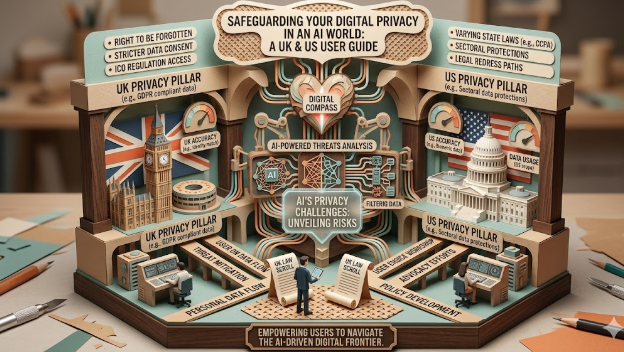
Safeguarding Your Digital Privacy in an AI World: A UK & US User Guide
The rise of Artificial Intelligence (AI) heralds an era of unprecedented technological advancement, transforming industries, enhancing daily conveniences, and opening new frontiers for innovation. From personalised recommendations to predictive analytics, AI is deeply embedded in our digital lives. However, this progress comes with a crucial question: what does it mean for our personal data and digital privacy? For users in the UK and the US, understanding and protecting your privacy in an AI-driven world is more vital than ever, given the distinct, yet interconnected, regulatory landscapes and technological challenges.
This guide offers practical strategies and essential tools to help you navigate the complexities of AI and safeguard your most valuable digital asset: your personal information.
Understanding AI’s Impact on Your Personal Data
AI systems are voracious data consumers. They learn, adapt, and make decisions by processing vast amounts of information, much of which is personal data. This includes everything from your browsing history and purchase patterns to biometric data and location information. While this data fuels convenient services, it also creates new vulnerabilities.
How AI Utilises Your Data:
- Personalisation: Tailoring content, ads, and product suggestions based on your past behaviour.
- Predictive Analytics: Forecasting future actions or preferences, often used in marketing or even law enforcement.
- Automated Decision-Making: AI algorithms making decisions about credit scores, insurance premiums, or job applications.
- Surveillance: Facial recognition, voice analysis, and behavioural tracking in public and private spaces.
Potential Risks to Your Privacy:
- Data Breaches: Large datasets held by AI companies become attractive targets for cybercriminals.
- Algorithmic Bias: AI systems can perpetuate or amplify existing biases present in their training data, leading to discriminatory outcomes.
- Lack of Transparency: It can be difficult to understand how AI systems process your data and make decisions (the ‘black box’ problem).
- Profiling: Detailed profiles created from your data can be sold or shared without your explicit consent.
Foundational Steps for Enhanced Digital Privacy
Before diving into AI-specific considerations, ensure your basic digital hygiene is impeccable. These steps form the bedrock of any robust data privacy strategy.
Strong, Unique Passwords and Multi-Factor Authentication (MFA)
Your first line of defense remains impenetrable passwords. Use a unique, complex password for every online account. Enable Multi-Factor Authentication (MFA) wherever possible – it adds an extra layer of security, typically requiring a code from your phone in addition to your password.
Regular Software Updates
Operating systems, applications, and browsers frequently release updates that include critical security patches. Ignoring these updates leaves you vulnerable to known exploits. Make sure all your devices and software are kept current.
Reviewing App Permissions
Many apps request access to more data than they genuinely need. Regularly audit the permissions you grant to apps on your smartphone or tablet. Limit access to your location, contacts, microphone, and camera unless absolutely essential for the app’s core function.
Using Privacy-Focused Browsers and Search Engines
Ditch browsers and search engines that extensively track your online activity. Consider alternatives like Brave Browser or Mozilla Firefox with enhanced tracking protection. For search, DuckDuckGo offers private search results without storing your personal information.
Ad Blockers and Tracking Protection
Install browser extensions like uBlock Origin or Privacy Badger to block intrusive ads and prevent third-party trackers from following your online movements.
Virtual Private Networks (VPNs)
A VPN encrypts your internet connection, masking your IP address and making your online activity much harder to trace. This is especially crucial when using public Wi-Fi networks. Reputable services like ExpressVPN, ProtonVPN, or NordVPN are good choices.
Navigating UK & US Data Protection Landscapes
Understanding your rights and the frameworks designed to protect your data is essential, particularly for ensuring your data privacy against AI’s pervasive reach in both the UK and US.
In the UK: GDPR and Beyond
The UK operates under its own version of the General Data Protection Regulation (UK GDPR) since Brexit, working in tandem with the Data Protection Act 2018. This robust framework grants individuals significant rights over their personal data.
Key UK GDPR Rights Include:
- Right to be Informed: Organisations must tell you how your data is being used.
- Right of Access: You can request a copy of the data an organisation holds about you.
- Right to Rectification: You can ask for incorrect data to be corrected.
- Right to Erasure (‘Right to be Forgotten’): You can request your data be deleted under certain circumstances.
- Right to Restrict Processing: You can limit how an organisation uses your data.
- Right to Data Portability: You can obtain and reuse your data for your own purposes across different services.
- Right to Object: You can object to the processing of your data in certain situations.
- Rights in Relation to Automated Decision Making and Profiling: Specific protections against solely automated decisions that have legal or significant effects on you.
The Information Commissioner’s Office (ICO) is the UK’s independent authority set up to uphold information rights and data privacy for individuals.
In the US: A Patchwork of Laws
Unlike the UK’s comprehensive federal approach, the US has a sector-specific and state-level approach to data privacy. There is no single overarching federal data privacy law comparable to GDPR.
Key US Privacy Regulations:
- California Consumer Privacy Act (CCPA) / California Privacy Rights Act (CPRA): Often seen as the closest US equivalent to GDPR, granting California residents rights to know what data is collected, to delete it, and to opt out of its sale.
- State-Level Laws: Other states like Virginia (VCDPA), Colorado (CPA), Utah (UCPA), and Connecticut (CTDPA) have enacted their own comprehensive privacy laws, creating a complex compliance landscape.
- Federal Trade Commission (FTC): The FTC acts as the primary federal agency for consumer protection, including enforcing privacy-related issues in commercial practices, but it lacks a broad data privacy mandate.
For US users, understanding the laws in your specific state is crucial, as your rights can vary significantly.
Practical Strategies for AI-Era Privacy
Beyond the foundational steps, adopting specific strategies can help you maintain control over your data in an AI-driven environment.
Minimising Your Digital Footprint
The less data you put out there, the less AI has to work with. Practice data minimisation by only providing essential information when signing up for services. Regularly review and delete old accounts you no longer use. Be mindful of public Wi-Fi networks, which can be vulnerable to interception.
Embracing Privacy-Enhancing Technologies (PETs)
Leverage tools specifically designed to protect your privacy:
- Password Managers: Services like LastPass, 1Password, or Bitwarden securely store your unique, complex passwords, making strong password hygiene effortless.
- Encrypted Communication: Use end-to-end encrypted messaging apps like Signal for private conversations. For email, consider ProtonMail or Tutanota, which offer encrypted email services.
Engaging Critically with AI Services
Whenever you use an AI-powered service:
- Read Privacy Policies: While often lengthy, try to understand what data an AI service collects, how it’s used, and whether it’s shared with third parties.
- Exercise Opt-Out Rights: Look for options to opt out of data sharing, personalised advertising, or certain types of data processing.
- Be Cautious with Voice Assistants: Understand that voice assistants (like Amazon Alexa or Google Assistant) record and process your voice commands, and sometimes inadvertently, background conversations. Adjust their privacy settings to limit data retention and review.
- Understand Biometric Data: Be aware of how facial recognition or fingerprint scanners on your devices are used and how that data is stored.
Responding to a Data Breach
Even with the best precautions, data breaches can occur. Knowing how to react quickly is crucial.
- Change Passwords: Immediately change passwords for any compromised accounts and any other accounts using the same password.
- Monitor Financial Accounts: Keep a close eye on bank statements and credit reports for suspicious activity. Consider placing a fraud alert.
- Notify Authorities: In the UK, report significant breaches to the ICO. In the US, report to the Federal Trade Commission (FTC) and your state’s Attorney General.
Frequently Asked Questions (FAQ)
Q1: Is my data truly safe with AI?
No system is 100% immune to risks. While AI offers many benefits, its reliance on vast datasets introduces new vulnerabilities for data breaches, misuse, and privacy infringements. Vigilance and proactive protection are essential.
Q2: What’s the biggest difference in data privacy between UK and US users?
The UK benefits from a comprehensive, federal data privacy framework (UK GDPR) that grants extensive rights to individuals. The US has a more fragmented approach with sector-specific and varying state-level laws, meaning your rights can differ based on where you live.
Q3: How do I know if an AI service respects my privacy?
Look for transparent privacy policies, clear opt-out options for data sharing, and certifications or statements about their data handling practices. Companies that value privacy often highlight their commitment and give users granular control over their data.
Q4: Can I opt out of AI data collection entirely?
It’s challenging to opt out entirely as AI is deeply integrated into many digital services. However, you can significantly reduce data collection by adjusting privacy settings, using privacy-focused tools, exercising your data rights (like the right to object or erase), and minimising your online footprint.
Q5: Are free VPNs safe for protecting my privacy?
Many free VPNs can compromise your privacy by logging your activity, injecting ads, or even selling your data. For genuine privacy protection, it’s generally recommended to use reputable, paid VPN services that have a clear no-logging policy.
Conclusion
Living in an AI-driven world demands a proactive and informed approach to digital privacy. While the convenience and innovation AI brings are undeniable, the responsibility to safeguard our personal data ultimately rests with each of us. By understanding how AI uses data, leveraging the robust regulatory frameworks in the UK, navigating the evolving laws in the US, and adopting strong personal privacy practices, you can confidently engage with technology while keeping your digital identity secure. Stay informed, stay vigilant, and empower yourself with the knowledge and tools to protect your privacy in this exciting, data-rich era.
Category: CYBERSECURITY
Tags: data privacy, AI security, UK privacy laws, US data protection, online safety, GDPR, CCPA, digital rights