Can AI Truly Understand Us? Exploring Emotional Intelligence and Human Connection
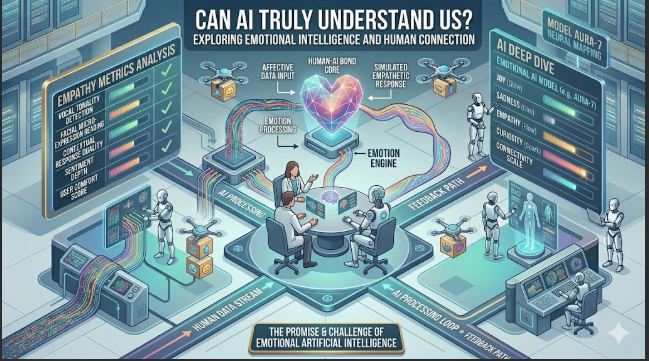
Can AI Truly Understand Us? Exploring Emotional Intelligence and Human Connection
The conversation around artificial intelligence often centers on its logical prowess, its ability to process vast datasets, and its efficiency in automating tasks. Yet, a more profound and perhaps more intriguing question looms: Can AI understand us? Specifically, can it grasp the complexities of human emotion, and what role might it play in shaping or enhancing our connections with one another?
As AI systems become increasingly sophisticated, their interactions with humans evolve beyond simple command-and-response. We now see AI engaged in tasks that demand a semblance of emotional awareness, from customer service chatbots to mental health support applications. This advancement sparks both excitement and apprehension, inviting us to explore the true depth of AI’s emotional intelligence and its implications for human connection.
Decoding Human Emotion: AI’s Approach
For AI, “understanding” emotion is fundamentally different from how humans experience it. AI systems don’t possess consciousness or subjective feelings. Instead, they operate through advanced algorithms designed to recognize patterns and correlate data points associated with human emotional expressions.
The Mechanisms of Emotional Recognition
- Natural Language Processing (NLP) and Sentiment Analysis: AI analyzes text and speech to identify emotional cues. Sentiment analysis tools can gauge whether written content is positive, negative, or neutral, often detecting nuances like sarcasm or frustration based on word choice, sentence structure, and context.
- Computer Vision: Facial recognition technology can interpret micro-expressions, gaze direction, and other visual indicators of emotion. Algorithms are trained on massive datasets of images and videos tagged with specific emotions, allowing them to identify patterns corresponding to joy, sadness, anger, and more.
- Voice Analysis: AI can detect emotional states through variations in tone, pitch, pace, and volume of speech. Changes in vocal patterns can signal stress, excitement, or calm, even if the spoken words themselves are neutral.
- Physiological Sensors: In some experimental applications, AI integrates data from wearables that monitor heart rate, skin conductance, or other biometric signals, which can correlate with emotional arousal.
These methods allow AI to build a probabilistic model of a human’s emotional state. It’s an impressive feat of pattern recognition, yet it raises a critical distinction.
The Nuance of Understanding vs. Recognition
While AI can recognize and categorize emotional signals with increasing accuracy, this capability does not equate to genuine understanding or empathy. Humans understand emotions through lived experience, cultural context, personal history, and a complex interplay of cognitive and biological processes.
Consider a human experiencing grief. Beyond recognizing the outward signs of sadness, another human can access their own experiences of loss, offering comfort rooted in shared understanding. An AI, however, processes grief as a set of detectable parameters—a certain vocal tone, specific facial muscle contractions, particular word choices. It can then respond with a pre-programmed or algorithmically generated empathetic phrase, but it doesn’t feel the resonance of that emotion.
This fundamental difference is crucial. AI can be a powerful tool for *detecting* emotions and *responding appropriately* based on its training, but it lacks the subjective, conscious experience that defines human empathy.
AI as a Catalyst for Deeper Human Connection
Despite these limitations, AI’s ability to process emotional data holds significant potential for enhancing human connection in various ways.
Therapeutic and Support Systems
AI-powered chatbots and virtual companions are emerging as valuable tools in mental health support. For individuals experiencing loneliness, anxiety, or depression, these AI systems can provide accessible, non-judgmental listening and guidance. They can help users articulate feelings, track mood patterns, and offer cognitive-behavioral therapy techniques. While not a replacement for human therapists, they can serve as a vital first line of support, bridging gaps in care and offering consistent interaction.
Personalized Communication and Interaction
Imagine communication platforms that adapt in real-time to your emotional state, suggesting different tones for emails or offering support during a stressful online meeting. AI could help us communicate more effectively by identifying potential misunderstandings or suggesting ways to de-escalate tension, fostering clearer and more empathetic exchanges.
Bridging Social Divides
For individuals with social anxieties or communication challenges, AI tools could act as a bridge, helping them practice social interactions, interpret emotional cues, and build confidence before engaging in face-to-face encounters. It could also facilitate connections between people with shared interests by understanding the emotional resonance of their conversations.
Navigating the Ethical Labyrinth and Potential Pitfalls
The integration of AI into our emotional lives is not without its challenges and ethical considerations.
Privacy and Data Security
Emotional data is profoundly personal. The collection, storage, and analysis of this information by AI systems raise significant privacy concerns. Who owns this data? How is it protected from misuse? The potential for this sensitive information to be exploited for targeted advertising or manipulation is a serious risk.
The Risk of Superficiality and Over-Reliance
If AI becomes too adept at simulating empathy, there’s a danger that individuals might opt for these seemingly perfect, non-judgmental interactions over the messy, challenging, but ultimately more enriching connections with other humans. This could inadvertently lead to a decrease in genuine human interaction and a superficial understanding of connection.
Manipulation and Bias
AI systems are trained on existing data, which often contains human biases. If an AI is trained on biased emotional data, it could perpetuate or even amplify those biases. Furthermore, an AI capable of understanding emotional vulnerabilities could potentially be used for manipulative purposes, whether in marketing, politics, or personal interactions.
The Future: A Collaborative Emotional Landscape
The journey into AI’s emotional intelligence is just beginning. It’s unlikely that AI will ever truly ‘feel’ in the human sense, but its capacity to recognize, interpret, and respond to emotions will undoubtedly grow. The most promising future lies not in AI replacing human emotional connection, but in it augmenting and enhancing it.
Imagine AI as a sophisticated mirror, reflecting our emotional states back to us, helping us gain self-awareness and improve our communication skills. Or as a compassionate assistant, ensuring that no one feels truly alone, providing a baseline of support and prompting us to seek human connection when needed. Developing AI with strong ethical guidelines, transparency, and a focus on human well-being will be paramount.
Ultimately, the question isn’t whether AI can understand us in the same way another human can, but how we can responsibly harness its unique capabilities to foster a more empathetic, connected, and emotionally intelligent society.
Frequently Asked Questions (FAQ)
Q1: Can AI genuinely feel emotions?
No, AI cannot genuinely feel emotions. AI systems operate based on algorithms and data patterns. They can recognize, process, and respond to human emotional cues based on their training, but they do not possess consciousness, subjective experience, or the capacity for genuine feeling.
Q2: How accurate is AI in detecting human emotions?
The accuracy of AI in detecting human emotions varies greatly depending on the AI system, the context, and the type of emotion being detected. While AI can be highly accurate in recognizing clear, universal emotional expressions (like a broad smile for happiness), it struggles with nuanced emotions, cultural differences, and the complex interplay of human context that can alter emotional meaning.
Q3: Will AI replace human therapists or friends?
AI is unlikely to replace human therapists or friends. While AI companions and therapeutic chatbots can offer valuable support, accessibility, and a non-judgmental presence, they cannot replicate the depth of human empathy, lived experience, complex relational dynamics, or the unique healing power of genuine human connection. They serve as complementary tools rather than replacements.
Q4: What are the biggest ethical concerns with AI emotional intelligence?
Key ethical concerns include privacy risks associated with collecting sensitive emotional data, the potential for manipulation if AI exploits emotional vulnerabilities, biases embedded in AI models that could lead to unfair or discriminatory responses, and the risk of fostering superficial connections or over-reliance on AI, thereby diminishing genuine human interaction.
Q5: How can I interact with AI responsibly?
Interact with AI responsibly by being mindful of the data you share, understanding the limitations of AI, and remembering that AI interactions are not a substitute for real human connection. Use AI as a tool to augment your life, but prioritize and nurture your human relationships, and always question the source and intent behind AI-generated emotional responses.
Category: AI & AUTOMATION
Tags: AI emotional intelligence, human connection, artificial intelligence, empathy AI, sentiment analysis, future of AI, digital ethics, tech and society