AI Content Creation’s Future: ChatGPT & Gemini Reshaping Digital Landscapes
AI Content Creation’s Future: ChatGPT & Gemini Reshaping Digital Landscapes
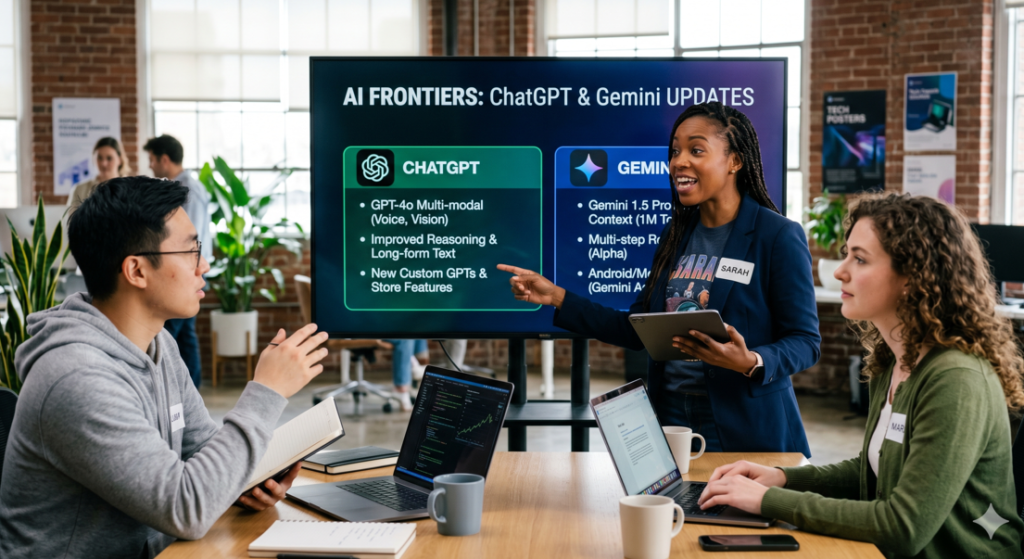
The digital realm constantly shifts, but few forces have impacted content creation as profoundly as advanced artificial intelligence. Large Language Models (LLMs) like OpenAI’s ChatGPT and Google’s Gemini are not just tools; they are catalysts, fundamentally altering how content is conceived, produced, and consumed. For writers, marketers, and creators, understanding this transformation is no longer optional—it’s essential for navigating the evolving landscape of AI content creation.
The Dawn of a New Era in Content Creation
For decades, AI in content creation was limited to rudimentary tasks like spell-checking or basic data aggregation. The advent of sophisticated generative AI models, particularly those leveraging transformer architectures, marked a significant leap. These systems can understand context, generate human-like text, and even produce creative content that was once thought to be exclusively human domain.
ChatGPT, from its initial public release, showcased an unprecedented ability to generate coherent and contextually relevant text across a myriad of topics and styles. Its user-friendliness democratized access to powerful AI, empowering individuals and small businesses to scale their content efforts. Gemini, Google’s multimodal answer, takes this a step further, integrating seamless understanding and generation across text, images, audio, and video, promising an even more versatile content creation future.
How ChatGPT and Gemini are Redefining Workflows
The practical applications of these LLMs extend far beyond simple text generation. They are integrating into every phase of the content lifecycle, from ideation to optimization.
Idea Generation and Brainstorming
Writer’s block is a common hurdle, but AI acts as an endless wellspring of ideas. Content creators can prompt ChatGPT or Gemini with a topic, audience, or desired angle, receiving dozens of potential headlines, article outlines, or even entire campaign concepts in moments. This speeds up the initial, often time-consuming, brainstorming phase, allowing human creators to focus on refining and selecting the most promising paths.
Drafting and Iteration
Generating first drafts, often the most arduous part of writing, becomes significantly faster with AI. Whether it’s blog posts, social media captions, email newsletters, or marketing copy, these tools can produce foundational text that humans then edit, refine, and infuse with their unique voice and expertise. The iterative process also benefits; asking AI to rephrase, expand, or condense paragraphs instantly provides multiple variations to consider.
Personalization at Scale
Tailoring content to specific audience segments is crucial for engagement. ChatGPT and Gemini enable hyper-personalization by generating variations of content based on user data, preferences, or demographic information. This means crafting dozens of unique product descriptions, ad copy variants, or email subject lines, each optimized for a distinct target, a task that would be logistically impossible for a human team to manage manually.
Multimodal Capabilities and Beyond
Gemini’s inherent multimodal design represents a significant step forward. It can interpret and generate content across different formats—text, images, audio, and video—opening doors for more dynamic and integrated content experiences. Imagine generating a script, then having AI suggest visual elements or even generate a basic storyboard. This capability points towards a future where content creation tools are truly holistic.
SEO and Optimization Assistance
For marketers, SEO remains paramount. AI can assist in keyword research by identifying relevant terms, suggest SEO-friendly headlines and meta descriptions, and even help restructure content for better readability and search engine performance. While human expertise in strategy and nuanced optimization remains critical, AI offers a powerful assistant for the technical aspects of SEO.
Challenges and Ethical Considerations
Despite their capabilities, the widespread adoption of AI tools like ChatGPT and Gemini brings forth important challenges and ethical dilemmas. Originality, voice, and potential biases are at the forefront.
- Maintaining Originality and Voice: Over-reliance on AI can lead to generic content. The human element—unique perspectives, empathy, and distinct brand voice—remains irreplaceable.
- Bias and Accuracy Concerns: AI models learn from vast datasets, which can contain inherent biases. This can lead to AI-generated content perpetuating stereotypes or providing inaccurate information. Human oversight is crucial for fact-checking and mitigating bias.
- Copyright and Ownership: The legal landscape around AI-generated content is still evolving. Questions of ownership, intellectual property, and fair use are complex and will require ongoing clarification.
- The Importance of Human Oversight: AI tools are powerful assistants, not autonomous creators. Human editors, strategists, and subject matter experts are indispensable for ensuring quality, accuracy, ethical compliance, and strategic alignment.
The Evolving Role of Human Creators
Rather than replacing human creators, AI is reshaping their roles. The future of AI content creation isn’t about humans competing with machines; it’s about humans collaborating with them.
- From Creation to Curation and Editing: Writers become adept editors and curators, refining AI-generated drafts, ensuring factual accuracy, and injecting the necessary human touch.
- Strategic Direction and Prompt Engineering: Marketers and strategists will focus more on defining the overarching content strategy, understanding audience needs, and mastering ‘prompt engineering’—the art of instructing AI effectively to yield desired results.
- Focus on Critical Thinking and Empathy: Tasks requiring deep critical thinking, emotional intelligence, nuanced understanding of human behavior, and genuine empathy will remain firmly in the human domain.
- Upskilling for AI Proficiency: Proficiency with AI tools will become a core skill for content professionals, much like knowing how to use a word processor or a CMS.
Future Trends and Predictions in AI Content Creation
The evolution of AI content creation is far from over. We can anticipate several key trends:
- Deeper Integration with Workflow Tools: AI capabilities will be seamlessly embedded into existing content management systems, design tools, and marketing platforms, making AI assistance an invisible, intuitive part of daily work.
- Hyper-Personalization and Dynamic Content: Content will become even more dynamic, adapting in real-time to individual user interactions, preferences, and contexts, driven by advanced AI.
- Emergence of AI-Powered Content Hubs: Centralized platforms will emerge where AI not only generates text but also designs visuals, edits video, and optimizes distribution, all from a single interface.
- The Blend of Human and AI Creativity: The most compelling content will likely be a synergistic blend—human ingenuity providing the vision and emotional depth, and AI providing the scale, speed, and technical precision.
Frequently Asked Questions (FAQ)
Will AI replace human content creators?
No, AI is unlikely to fully replace human content creators. Instead, it will transform their roles. Humans will shift from pure content generation to overseeing, editing, fact-checking, and providing strategic direction, leveraging AI as a powerful assistant to enhance productivity and scale.
How can I leverage ChatGPT and Gemini effectively?
To use these tools effectively, focus on clear and specific prompting. Experiment with different instructions, provide context, and define the desired tone and style. Use AI for idea generation, drafting, research summarization, and task automation, reserving your human expertise for critical thinking, emotional resonance, and final refinement.
What are the main ethical concerns with AI content generation?
Key ethical concerns include potential biases in AI-generated content, risks of misinformation if not fact-checked, issues around originality and plagiarism, and the environmental impact of large model training. Responsible use requires transparency, human oversight, and a commitment to ethical guidelines.
How do ChatGPT and Gemini differ?
While both are powerful LLMs, Gemini is designed from the ground up as a multimodal AI, meaning it can natively understand and operate across different types of information (text, images, audio, video). ChatGPT, while evolving, primarily started as a text-based model. Gemini also integrates more directly with Google’s ecosystem.
Is AI-generated content detectable?
While specific AI detection tools exist, their accuracy is often debated and can be inconsistent. The more a human edits and refines AI-generated content, the harder it becomes to distinguish. The focus should be on creating high-quality, helpful content, regardless of the tools used, rather than solely on avoiding detection.
A Collaborative Future
The future of AI content creation is a collaborative one. ChatGPT and Gemini stand as testaments to technological progress, offering unprecedented opportunities for efficiency, scale, and innovation. However, their true power lies not in their ability to operate autonomously, but in their capacity to augment human creativity and intelligence. For those willing to adapt, learn, and ethically integrate these tools, the digital landscape ahead promises to be more dynamic and exciting than ever before.
Category: AI & AUTOMATION
Tags: AI content creation, ChatGPT, Gemini, Content marketing, Future of writing, Generative AI, Digital strategy, Content tools