AI Features in Smartphone Cameras: Redefining Mobile Photography and Video
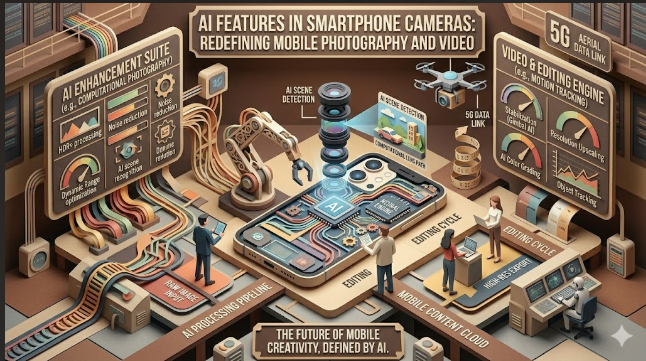
AI Features in Smartphone Cameras: Redefining Mobile Photography and Video
The smartphone in your pocket has quietly become one of the most powerful imaging devices ever created, not just because of its impressive hardware, but thanks to an invisible revolution: Artificial Intelligence. What once required bulky professional gear and extensive post-processing can now be achieved with a tap on a screen, all powered by sophisticated AI features in smartphone cameras. From breathtaking landscapes to perfectly lit portraits and cinematic video, AI isn’t just assisting; it’s fundamentally redefining what mobile photography and videography can accomplish.
For years, smartphone cameras faced inherent limitations – small sensors, tiny lenses, and the physical constraints of a slim device. The pursuit of optical perfection hit a wall. Enter AI, a game-changer that leveraged computational power to overcome these physical barriers, transforming raw sensor data into stunning, professional-grade imagery. This isn’t just about applying a filter; it’s about intelligence making real-time decisions, enhancing every pixel, and anticipating your photographic needs.
The Dawn of Intelligent Imaging: Beyond the Lens
The journey of AI in mobile cameras began subtly, with features like basic scene detection or smile recognition. Today, it’s an intricate dance of algorithms and machine learning models that work tirelessly behind the scenes. When you point your smartphone camera, AI is already at work, analyzing the scene, identifying subjects, and optimizing countless parameters before you even press the shutter button. This paradigm shift means the camera is no longer just a light-capturing device; it’s an intelligent visual processor.
AI Features in Smartphone Cameras: A Deep Dive into Innovation
Computational Photography: The Brain Behind the Beauty
Perhaps the most impactful application of AI in mobile cameras is computational photography. This isn’t about capturing a single image; it’s about capturing multiple images, analyzing them, and intelligently combining them into one superior final product. AI algorithms analyze each frame for detail, color, and exposure, stitching them together to create an image that surpasses the capabilities of the individual captures.
- Night Mode: Once a weak point for smartphone cameras, AI-powered Night Modes (like Google Pixel’s Night Sight or Apple’s Night Mode) capture dozens of frames at different exposures, use AI to align them, remove noise, and enhance detail and color, delivering bright, clear images even in near darkness.
- HDR+ (High Dynamic Range): AI intelligently balances exposure across extremely bright and dark areas in a single shot, preventing blown-out highlights and crushed shadows. It analyzes multiple bracketed exposures and composites them to create a single, perfectly exposed image that mirrors what the human eye sees.
- Portrait Mode: AI is crucial for creating the pleasing ‘bokeh’ effect, accurately distinguishing the subject from the background to apply a natural-looking blur. Modern AI goes further, allowing adjustments to the depth of field after the photo is taken, and even simulating different lighting conditions.
Scene and Object Recognition: Smarter Shots, Instantly
Modern smartphone cameras don’t just see; they understand. AI-driven scene and object recognition can instantly identify what you’re photographing – be it a plate of food, a pet, a sprawling landscape, or a person. Based on this recognition, the camera automatically adjusts settings like white balance, saturation, contrast, and exposure to optimize the shot. For instance, a Samsung Galaxy phone might boost colors for food photography or enhance greens for a nature scene. Apple’s Photographic Styles also leverage AI to apply subtle, intelligent adjustments to images at the point of capture, preserving skin tones while customizing overall look.
Real-Time Editing and Enhancement: Post-Processing on the Fly
The editing suite is no longer a separate application. AI is integrating editing capabilities directly into the camera experience, and often, after the fact with impressive results.
- Magic Eraser: Features like Google Pixel’s Magic Eraser allow users to effortlessly remove unwanted objects or photobombers from photos with incredible precision, thanks to advanced AI object detection and content-aware fill algorithms. Samsung’s Object Eraser offers similar functionality.
- Generative Fill: Beyond removal, AI can now generate content. Samsung’s Generative Edit can intelligently fill in gaps or extend backgrounds in images, while AI upscaling tools can dramatically improve the resolution and detail of older, lower-quality photos.
- Intelligent Filters & Styles: Rather than simple overlays, AI-powered filters can understand image content and apply enhancements contextually, adjusting skin tones, lighting, and textures in a more sophisticated and natural way. Apps like Google Photos and Adobe Photoshop Express heavily leverage AI for one-tap enhancements and powerful editing tools.
Revolutionizing Mobile Videography: More Than Just Frames
While photography has seen significant AI advancements, video capabilities are catching up rapidly. AI is transforming how we capture and produce moving images on our phones.
- Cinematic Mode & Portrait Video: Phones like the iPhone 13 and newer, and some Samsung Galaxy models, offer ‘Cinematic Mode’ or ‘Portrait Video’. This uses AI to create a shallow depth of field effect, automatically shifting focus between subjects as they move or as the scene dictates, mimicking professional cinema cameras.
- Advanced Stabilization: Beyond optical and electronic image stabilization, AI analyzes motion patterns to predict and counteract shakes, resulting in remarkably smooth footage, even when moving.
- Object Tracking: AI can lock onto a subject and keep it in frame and in focus, even if they move erratically. This is invaluable for capturing dynamic action shots or lively pets and children.
- AI-Powered Editing: Some devices and apps can automatically identify highlights, create highlight reels, or suggest edits for your video clips, reducing the time and effort required for basic video production.
The User Experience: Democratizing Professional Photography
Perhaps the most profound impact of AI in smartphone cameras is the democratization of advanced photographic techniques. Complex processes that once required manual adjustments, specialized knowledge, and expensive gear are now handled autonomously by AI. This means anyone, regardless of their photographic skill level, can consistently capture stunning, high-quality photos and videos. AI acts as an invisible co-pilot, guiding users to better results without them even realizing the intricate computations happening in milliseconds.
The Road Ahead: Challenges and Opportunities
As AI continues to evolve, so too will mobile imaging. We can anticipate even more sophisticated computational photography, real-time generative image creation, and perhaps even AI-driven storytelling tools. However, this advancement also brings challenges, including ethical considerations around image manipulation, deepfakes, and the potential for AI to create images that are almost too perfect, blurring the lines between reality and algorithmically enhanced perception. Balancing innovation with responsibility will be key to the future of AI in mobile photography.
Frequently Asked Questions About AI in Mobile Photography
Q1: What exactly are AI features in smartphone cameras?
AI features in smartphone cameras refer to the use of artificial intelligence and machine learning algorithms to enhance every aspect of image and video capture and processing. This includes tasks like scene recognition, object detection, computational photography (e.g., Night Mode, HDR), real-time editing, and advanced video stabilization and effects.
Q2: How does AI improve low-light photography on smartphones?
AI significantly improves low-light photography through computational techniques. It captures multiple frames at various exposures, aligns them, reduces digital noise, and intelligently brightens and enhances details and colors, resulting in much clearer and more vibrant images than would be possible with hardware alone.
Q3: Is AI-enhanced photography truly “real” or is it artificial?
AI-enhanced photography uses computational methods to produce an image that often looks more appealing or closer to what the human eye perceives than a raw, single-frame capture. While it processes and combines information, the goal is often to create a visually accurate or aesthetically pleasing representation, rather than a fabricated one, though advanced generative AI can indeed create entirely new elements.
Q4: Which smartphones have the best AI camera features?
Many leading smartphone brands excel in AI camera features. Google Pixel phones are renowned for their computational photography (Night Sight, Magic Eraser). Apple’s iPhones offer strong AI integration for Smart HDR, Cinematic Mode, and Photographic Styles. Samsung Galaxy devices feature robust scene optimization and generative editing capabilities.
Category: AI & AUTOMATION
Tags: AI photography, mobile camera AI, smartphone photography, computational photography, AI video editing, camera technology, mobile tech, image processing