


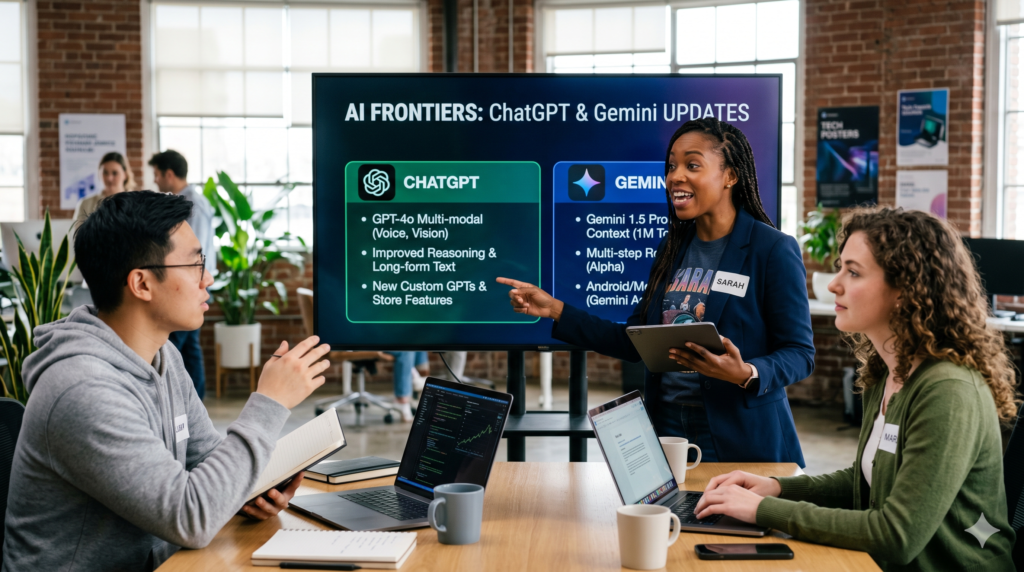
ChatGPT & Gemini: Staying Ahead with the Latest AI Innovations
The landscape of artificial intelligence is in a constant state of flux, with leading models like OpenAI’s ChatGPT and Google’s Gemini pushing boundaries at an astonishing pace. For anyone looking to leverage these powerful tools, or simply understand their impact, keeping up with the latest updates is crucial. These advancements aren’t just incremental; they often represent fundamental shifts in how we interact with AI, what it can achieve, and the problems it can solve. Let’s explore the most significant recent developments from both ChatGPT and Gemini.
Diving Deep into ChatGPT’s Advancements
OpenAI has consistently rolled out features that redefine user interaction with its flagship model, ChatGPT. Recent updates have focused on enhancing customization, expanding multimodal capabilities, and refining core performance.
The Rise of Custom GPTs and the GPT Store
One of the most impactful recent additions is the introduction of Custom GPTs. This feature allows users to tailor ChatGPT for specific tasks, knowledge domains, or interaction styles without any coding. Imagine a personalized study assistant, a recipe generator that understands your dietary restrictions, or a coding mentor focused on a particular language. These custom versions can be configured with specific instructions, external knowledge sources, and even actions that connect to real-world applications. The subsequent launch of the GPT Store then provided a marketplace for creators to share and monetize their custom GPTs, fostering a vibrant ecosystem of specialized AI applications.
Enhanced Multimodality: Vision and Voice
ChatGPT has transcended text-only interactions. Its expanded multimodal capabilities now allow users to engage using voice and vision. Users can speak directly to ChatGPT, receiving spoken responses, making the interaction feel more natural and intuitive. Furthermore, the ability to upload images and ask questions about their content has unlocked new possibilities. ChatGPT can analyze charts, describe complex scenes, or help debug code from a screenshot, integrating visual information seamlessly into its understanding and response generation.
GPT-4 Turbo and API Improvements
Under the hood, OpenAI continues to refine its foundational models. The introduction of GPT-4 Turbo brought a significant leap in capabilities, offering a larger context window, more up-to-date knowledge, and improved instruction following at a more competitive price point for developers. These improvements extend to the API, allowing developers to build more sophisticated and efficient applications that harness the full power of OpenAI’s models, including new Assistants API and DALL-E 3 integration.
Unpacking Gemini’s Latest Capabilities
Google’s entry into the advanced large language model space with Gemini has been ambitious, focusing on native multimodality and deep integration across its ecosystem. Google has consolidated its AI offerings under the Gemini brand, moving past Bard and other initiatives to create a unified experience.
The Gemini Family: Ultra, Pro, and Nano
Google launched Gemini with a tiered approach, offering models optimized for different use cases and computational needs. Gemini Ultra represents the largest and most capable model, designed for highly complex tasks. Gemini Pro powers the core Gemini experience (formerly Bard), offering a balance of performance and efficiency for a wide range of applications. Finally, Gemini Nano is a compact, on-device model designed for mobile devices, enabling AI features directly on smartphones without constant cloud connectivity.
Native Multimodality from the Ground Up
A key differentiator for Gemini is its design as a natively multimodal model. Unlike other models that might integrate different modalities (text, image, audio, video) as separate components, Gemini was trained to understand and reason across these different types of information from its inception. This allows for more nuanced understanding and generation, such as interpreting complex visual data alongside textual prompts or summarizing video content.
Deep Integration Across Google Ecosystem
Gemini is not just a standalone chatbot; it’s designed to be a fundamental layer across Google’s vast product ecosystem. It powers the new Gemini conversational AI experience, enhances features within Google Workspace (e.g., helping draft emails in Gmail or generate content in Docs), and is integrated into Android devices via Gemini Nano for on-device smart features. This deep integration aims to make AI assistance pervasive and contextually relevant throughout a user’s digital life.
ChatGPT vs. Gemini: What These Updates Mean for Users
While both platforms aim to provide powerful AI capabilities, their recent updates highlight differing strategic priorities and strengths.
Key Differentiators and Use Cases
- Customization vs. Integration: ChatGPT, with its Custom GPTs and thriving Store, emphasizes user-driven customization and a broad, open ecosystem for specialized AI tools. Gemini, conversely, leans into seamless integration within the Google ecosystem, making its AI capabilities feel like an inherent part of familiar Google services.
- Multimodal Approach: Both offer multimodality, but Gemini’s native approach, especially with video analysis, might offer deeper, more integrated understanding for certain complex tasks involving multiple data types. ChatGPT’s multimodal features are incredibly powerful, particularly its voice and image understanding, and are continuously improving.
- Developer Focus: OpenAI continues to provide robust APIs and developer tools, fostering innovation from external developers. Google’s approach with Gemini also includes developer access, but its emphasis on internal product integration is equally strong.
The Road Ahead: What to Expect
The competition between ChatGPT and Gemini is a powerful catalyst for innovation. Users can anticipate:
- Increased Personalization: AI models will become even better at understanding individual preferences, context, and history, leading to more tailored and proactive assistance.
- Enhanced Reasoning: Both models will continue to improve their ability to handle complex logical tasks, mathematical problems, and nuanced understanding of human language.
- Broader Multimodal Horizons: Expect more sophisticated handling of video, richer audio interactions, and potentially new modalities like touch or spatial awareness.
- Ethical AI Development: As AI becomes more powerful, focus on safety, fairness, and transparency will intensify, with both companies investing heavily in responsible AI development.
Frequently Asked Questions About ChatGPT and Gemini Updates
Q1: What are Custom GPTs and how do they differ from the main ChatGPT?
A1: Custom GPTs are personalized versions of ChatGPT that you can create and train for specific purposes, knowledge domains, or interaction styles. They differ from the main ChatGPT by having tailored instructions, access to specific external knowledge (e.g., documents), and the ability to perform actions through APIs, making them highly specialized tools.
Q2: How does Gemini’s native multimodality work compared to ChatGPT’s?
A2: Gemini was designed from the ground up to understand and reason across multiple modalities (text, image, audio, video) simultaneously. This means it can process and integrate different types of information more inherently. ChatGPT has also rapidly evolved its multimodal capabilities, allowing robust voice interactions and image analysis, continually blurring the lines between these approaches.
Q3: Is Gemini replacing Bard?
A3: Yes, Google has rebranded and consolidated its conversational AI experience under the single name “Gemini.” The previous product known as Bard is now simply Gemini, powered by the Gemini family of models (primarily Gemini Pro).
Q4: What’s the main benefit of Gemini Nano being on-device?
A4: Gemini Nano, being an on-device model, allows AI features to run directly on your smartphone without needing constant internet connectivity or sending data to the cloud. This offers benefits like faster response times, enhanced privacy, and the ability to use AI features even when offline.
Q5: Where can I find the latest official updates for these AI models?
A5: For ChatGPT and OpenAI developments, regularly check the OpenAI Blog. For Gemini and Google AI advancements, visit the Google AI Blog or the official Gemini website.
The Continuing Evolution of AI
The pace of innovation in AI, particularly with large language models like ChatGPT and Gemini, shows no signs of slowing. These latest updates underscore a clear trend: AI is becoming more personalized, more versatile, and more deeply integrated into our daily workflows and devices. Staying informed about these advancements isn’t just about keeping up with technology; it’s about understanding new possibilities for productivity, creativity, and problem-solving. As these models continue to evolve, their impact on how we work, learn, and interact with information will only grow more profound.
Category: AI TOOLS
Tags: ChatGPT updates, Gemini innovations, AI advancements, large language models, OpenAI, Google AI, custom GPTs, multimodal AI