


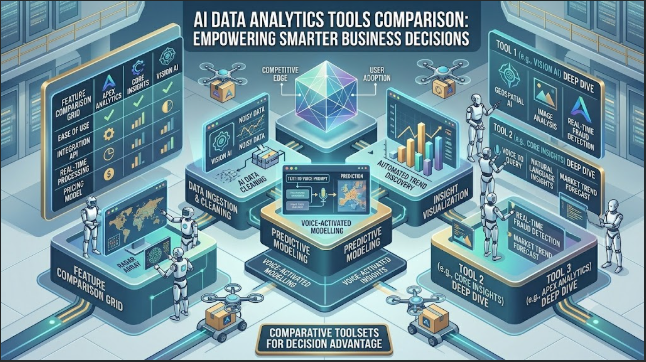
AI Data Analytics Tools Comparison: Empowering Smarter Business Decisions
In today’s competitive landscape, data is more than just numbers; it’s the raw material for strategic advantage. Businesses are drowning in data, yet often starved for actionable insights. This is where artificial intelligence (AI) steps in, transforming raw data into intelligence that drives smarter decisions and enhances human understanding.
AI-powered analytics tools don’t just process information faster; they uncover hidden patterns, predict future trends, and automate complex analyses that would be impossible for humans alone. They augment the human decision-making process, allowing teams to focus on strategy and innovation rather than endless data sifting. Understanding which platform best suits your organization’s needs is crucial for harnessing this power effectively.
The Transformative Power of AI in Data Analytics
Before diving into specific tools, it’s worth appreciating the fundamental shift AI brings to data analytics:
- Predictive Capabilities: AI models can forecast future outcomes, from sales trends to customer churn, with remarkable accuracy. This allows businesses to be proactive rather than reactive.
- Pattern Recognition: AI excels at identifying subtle correlations and anomalies in vast datasets that human analysts might miss.
- Automation: Routine data preparation, cleaning, and model building can be automated, freeing up data scientists for more complex tasks.
- Personalization: AI can analyze individual user behavior to deliver tailored recommendations and experiences, boosting engagement and customer satisfaction.
- Enhanced Business Intelligence: By integrating advanced analytics directly into BI platforms, AI makes sophisticated insights accessible to a broader audience within an organization.
Ultimately, AI data analytics tools are not about replacing human insight but about amplifying it. They provide the evidence and predictions that enable leaders to make more informed, data-driven choices.
Leading AI Data Analytics Tools Compared
Many robust platforms offer AI-driven analytics. We’ll compare some of the top contenders, highlighting their strengths and ideal use cases.
1. Tableau (Salesforce Tableau CRM & Einstein Analytics)
Tableau, now part of Salesforce, is renowned for its powerful data visualization capabilities and user-friendly interface. It allows users to quickly connect to various data sources, create interactive dashboards, and drill down into data with ease. With the integration of Salesforce’s Einstein Analytics (now Tableau CRM), Tableau significantly enhances its AI capabilities.
- Strengths: Exceptional data visualization, intuitive drag-and-drop interface, strong community support, robust integration with Salesforce ecosystem. Einstein Analytics provides predictive modeling, natural language querying (Ask Data), and automated insights directly within workflows.
- Ideal for: Businesses prioritizing visual exploration, storytelling with data, and those already invested in the Salesforce platform seeking embedded AI.
- Learn more: Tableau Official Site
2. Microsoft Power BI
Microsoft Power BI is a formidable business intelligence tool that leverages AI and machine learning capabilities, especially for users within the Microsoft ecosystem. It offers a comprehensive suite of services, including data preparation, modeling, visualization, and sharing.
- Strengths: Seamless integration with other Microsoft products (Excel, Azure, SQL Server), strong self-service BI features, competitive pricing model (especially for existing Microsoft users), includes AI features like Q&A (natural language queries), Key Influencers, and Anomaly Detection.
- Ideal for: Organizations deeply integrated with Microsoft technologies, small to large businesses looking for a cost-effective yet powerful BI and analytics solution.
- Learn more: Microsoft Power BI Official Site
3. Google Cloud Vertex AI & Looker
Google Cloud offers a powerful, scalable suite for AI and data analytics. Vertex AI unifies Google Cloud’s machine learning products into a single platform for building, deploying, and scaling ML models. Looker, acquired by Google, serves as a modern business intelligence and data platform within this ecosystem, focusing on real-time data exploration and a unified data model.
- Strengths: Unparalleled scalability for large datasets, advanced machine learning capabilities (custom model training, AutoML, pre-trained APIs), strong integration with other Google Cloud services, Looker provides a powerful semantic layer for consistent data definitions across the organization.
- Ideal for: Enterprises with massive datasets, data science teams building custom AI models, and organizations requiring highly scalable, cloud-native analytics solutions.
- Learn more: Google Cloud Vertex AI | Google Cloud Looker
4. SAS Viya
SAS has been a leader in statistical analysis for decades, and SAS Viya is its cloud-native, in-memory analytics engine. It provides a comprehensive platform for data science, machine learning, and AI, catering to a wide range of analytical needs from data preparation to deployment of AI models.
- Strengths: Robust statistical analysis capabilities, comprehensive suite for the entire analytical lifecycle, strong governance and security features, excellent for complex, large-scale enterprise analytics. Its AI capabilities include natural language processing, computer vision, and forecasting.
- Ideal for: Large enterprises, financial institutions, and organizations with complex regulatory requirements and a need for deep statistical rigor and advanced analytics.
- Learn more: SAS Viya Official Site
5. DataRobot
DataRobot specializes in automated machine learning (AutoML), aiming to democratize AI by making it accessible to a wider audience, including business analysts without deep data science expertise. It automates much of the model building, deployment, and monitoring process.
- Strengths: Strong AutoML capabilities, rapid model development and deployment, extensive library of open-source algorithms, focuses on explainable AI to help users understand model predictions, reducing the need for highly specialized data scientists.
- Ideal for: Businesses looking to quickly build and deploy machine learning models, organizations with a shortage of highly skilled data scientists, and those aiming to integrate predictive insights across various business functions.
- Learn more: DataRobot Official Site
Choosing the Right AI Analytics Tool for Your Business
The ‘best’ tool is subjective and depends heavily on your specific business context. Consider the following factors:
- Data Volume and Complexity: How much data do you generate, and how varied are its sources?
- Existing Infrastructure: What existing databases, cloud platforms, or CRM systems do you use? Integration is key.
- User Skill Level: Do you have a dedicated team of data scientists, or do you need tools that empower business analysts?
- Specific Use Cases: Are you focused on customer segmentation, fraud detection, predictive maintenance, or something else entirely?
- Budget: Licensing, infrastructure, and training costs can vary significantly.
- Scalability: Will the tool grow with your business needs and increasing data volumes?
Pilot programs and proofs-of-concept with a few shortlisted tools can provide invaluable insights into their practical applicability within your unique environment.
Frequently Asked Questions About AI Data Analytics Tools
Q1: What is the primary benefit of using AI in data analytics?
The primary benefit is transforming raw data into actionable insights and predictions with greater speed, accuracy, and depth than traditional methods. AI can uncover hidden patterns, automate complex analyses, and forecast future trends, empowering businesses to make proactive, data-driven decisions and gain a competitive edge.
Q2: Can AI data analytics tools replace human data scientists?
No, AI data analytics tools are designed to augment, not replace, human data scientists and analysts. While AI automates repetitive tasks and provides advanced insights, human expertise is crucial for defining business problems, interpreting AI output, validating models, ethical considerations, and translating insights into strategic actions. AI tools empower humans to be more efficient and impactful.
Q3: How difficult is it to integrate these tools with existing business systems?
Integration difficulty varies significantly by tool and your existing infrastructure. Many modern AI analytics platforms offer extensive connectors for popular databases, cloud services, and business applications like CRM and ERP. However, older or highly customized systems might require more effort, potentially involving APIs or custom development. Cloud-native solutions often integrate seamlessly within their respective cloud ecosystems.
Q4: Are AI analytics tools only for large enterprises?
While many advanced AI analytics platforms are tailored for large enterprises, there are increasingly accessible and scalable options for small and medium-sized businesses (SMBs). Tools like Microsoft Power BI and even simplified versions of Tableau offer powerful AI features at a more approachable price point and with user-friendly interfaces, making AI analytics achievable for businesses of all sizes.
Q5: What’s the difference between business intelligence (BI) and AI analytics?
Business Intelligence (BI) primarily focuses on descriptive and diagnostic analytics, answering ‘what happened’ and ‘why did it happen’ using historical data, often through dashboards and reports. AI analytics, on the other hand, extends into predictive and prescriptive analytics, answering ‘what will happen’ and ‘what should we do about it.’ AI uses machine learning algorithms to identify future trends, automate insights, and recommend actions, taking BI a significant step further.
Final Thoughts
The landscape of AI data analytics tools is rich and rapidly evolving. By carefully evaluating your organizational needs, technical capabilities, and strategic goals, you can select a platform that not only processes data but also transforms it into a powerful engine for innovation and growth. Embracing AI in your analytics strategy isn’t just about keeping up; it’s about leading the way into a more informed and intelligent future.
Category: DATA SCIENCE & ANALYTICS
Tags: AI analytics, data science, business intelligence, machine learning, predictive analytics, data analysis tools, enterprise AI, business insights