


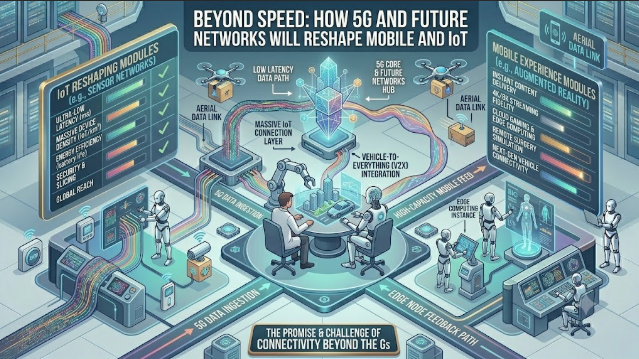
Beyond Speed: How 5G and Future Networks Will Reshape Mobile and IoT
When 5G was first introduced, much of the discourse centered on its unprecedented speed. While indeed significantly faster than its predecessors, focusing solely on gigabits per second misses the profound, transformative implications of this technology. 5G, and the foundational advancements it brings, is not merely an incremental upgrade; it is a catalyst for reshaping the very fabric of mobile computing, the Internet of Things (IoT), and the deployment of real-time artificial intelligence. This evolution lays the groundwork for 6G, promising an even more integrated and intelligent future.
The Foundational Shift: Beyond Gigabits Per Second
The true power of 5G lies in three critical enhancements beyond raw speed:
- Ultra-Low Latency: The time it takes for data to travel from source to destination is drastically reduced, often to single-digit milliseconds. This is crucial for applications requiring immediate feedback.
- Massive Machine-Type Communications (mMTC): 5G is designed to connect an astronomical number of devices simultaneously—up to a million devices per square kilometer. This capability is paramount for the expansion of IoT.
- Enhanced Mobile Broadband (eMBB): While not the sole focus, the increased bandwidth certainly enables richer mobile experiences, from high-definition streaming to immersive augmented and virtual reality.
- Network Slicing: This allows network operators to create virtual, isolated network slices tailored to specific application requirements, ensuring guaranteed performance for diverse services like autonomous vehicles or critical healthcare devices.
These features collectively represent a paradigm shift, moving wireless communication from a ‘best effort’ service to one that can guarantee performance metrics vital for mission-critical applications. This is the bedrock upon which the next generation of mobile and IoT experiences will be built.
Reshaping Mobile: A New Era of Device Capabilities
Mobile devices, from smartphones to wearables, are on the cusp of a significant evolution thanks to 5G. It’s not just about faster downloads; it’s about a fundamental change in how these devices interact with the world and process information.
- Immersive AR/VR Experiences: With ultra-low latency and high bandwidth, mobile AR and VR applications will become truly seamless and interactive. Imagine real-time holographic calls or educational content that fully integrates digital objects into your physical environment without lag.
- Real-Time Edge AI: Instead of relying solely on cloud servers, 5G enables more AI processing to occur at the ‘edge’—on the device itself or nearby edge servers. This means faster responses for voice assistants, real-time image recognition, and context-aware applications that understand user intent instantly.
- Cloud-Native Gaming and Applications: The distinction between local processing and cloud processing blurs. Mobile devices will seamlessly stream high-fidelity games and resource-intensive applications from the cloud with virtually no perceptible delay, freeing up device hardware and extending battery life for other tasks.
- Enhanced Connectivity for Wearables: Smartwatches, health trackers, and other wearables will gain more independent functionality, capable of direct, always-on connectivity for critical data transmission and proactive alerts, enhancing personal safety and health monitoring.
The Internet of Things Unleashed: Intelligent, Ubiquitous Connectivity
The 5G impact on IoT devices is perhaps the most profound. Previously, many ambitious IoT projects were hampered by connectivity limitations—either too slow, too unreliable, or too power-hungry. 5G addresses these directly, enabling a new wave of truly intelligent and interconnected environments.
- Smart Cities Transformed: From intelligent traffic management systems that dynamically adjust to real-time conditions to smart grids that optimize energy distribution, 5G-powered IoT sensors will provide unprecedented levels of urban insight and efficiency. Public safety can be enhanced with connected cameras and sensors providing real-time data to emergency services.
- Industrial IoT (IIoT) and Industry 4.0: Factories will become fully automated and predictive. 5G facilitates real-time monitoring of machinery, enabling predictive maintenance, robotic automation, and supply chain optimization on a scale previously impossible. This leads to higher efficiency, reduced downtime, and safer working conditions.
- Healthcare Revolutionized: The ability to connect vast numbers of medical IoT devices with low latency is a game-changer. Remote patient monitoring will become more sophisticated, enabling continuous tracking of vital signs and immediate alerts for medical professionals. Future applications include remote-assisted surgery with haptic feedback, breaking geographical barriers for specialized care.
- Precision Agriculture: IoT sensors deployed across farms can monitor soil conditions, crop health, and livestock in real-time. 5G connectivity ensures that this data reaches agricultural management systems instantly, allowing for highly targeted irrigation, fertilization, and pest control, optimizing yields and reducing waste.
The Symbiotic Rise of Real-Time AI and Edge Computing
5G’s low latency and high bandwidth are perfect companions for the growing power of Artificial Intelligence, particularly at the edge. Edge computing involves processing data closer to its source, rather than sending it all to a central cloud server. 5G makes this feasible on a massive scale.
Consider autonomous vehicles: for a car to make split-second decisions about braking or steering, it cannot afford the delay of sending data to a distant cloud. 5G allows AI models to run on roadside units or within the vehicle itself, providing instantaneous responses critical for safety. Similarly, smart cameras can perform real-time object detection and anomaly flagging without overwhelming central servers, enhancing security and operational efficiency. This combination pushes AI from being a purely data-center phenomenon to an omnipresent, responsive intelligence embedded in our environments.
Glimpse into 6G: The Next Horizon of Hyper-Connectivity
Even as 5G continues its global rollout, research into 6G networks is already underway. While still in its nascent stages, 6G promises to push boundaries even further:
- Terabit Speeds & Sub-Millisecond Latency: Imagine holographic communications and digital twins that are indistinguishable from reality, requiring immense bandwidth and virtually zero delay.
- Integrated Sensing and Communication: 6G networks are envisioned to not only transmit data but also to sense the environment around them. This could mean highly accurate indoor positioning, gesture recognition, and even health monitoring directly from network signals.
- AI-Native Networks: 6G networks are expected to be designed with AI from the ground up, allowing for unprecedented self-optimization, resource management, and predictive capabilities, making them incredibly efficient and resilient.
- Pervasive AI and Digital Twins: The digital and physical worlds will merge more seamlessly, with constantly updated digital replicas of physical objects and environments (digital twins) supported by ubiquitous AI, enabling predictive modeling and real-time control across vast systems.
Challenges and the Road Ahead
The journey to fully realize the potential of 5G and 6G is not without its hurdles. Significant investment is required for infrastructure deployment, particularly in rural and underserved areas. Cybersecurity becomes an even greater concern with billions of connected IoT devices, demanding robust and innovative security protocols. Regulatory frameworks need to adapt to new technologies and services, ensuring fair access and data privacy. Furthermore, the energy consumption of these vast networks and connected devices needs to be managed sustainably.
However, the trajectory is clear. 5G has laid a robust foundation for a world where connectivity is not just about communication, but about intelligence, automation, and a new level of interaction between humans, devices, and their environments. The full 5G impact on IoT devices is still unfolding, and future networks like 6G will accelerate this transformation even further.
FAQ Section
Q1: What is the main difference between 5G and previous generations like 4G?
A1: Beyond significantly higher speeds, 5G offers ultra-low latency (critical for real-time applications), massive connectivity (supporting millions of IoT devices), and network slicing (allowing customized network performance for different services), which 4G cannot achieve.
Q2: How will 5G benefit smart homes and smart cities?
A2: In smart homes, 5G enables seamless, reliable connection for all devices, facilitating advanced automation and real-time data processing. For smart cities, it powers intelligent traffic systems, connected public safety solutions, environmental monitoring, and efficient utility management by connecting vast networks of sensors and devices.
Q3: Is 6G just a faster version of 5G?
A3: While 6G will offer even greater speeds and lower latency, it’s envisioned as far more than just a faster 5G. It aims for integrated sensing and communication, AI-native networks, and a deeper convergence of the physical and digital worlds, enabling truly immersive experiences like holographic communication and digital twins.
Q4: What are the biggest challenges in deploying 5G and future networks?
A4: Key challenges include the significant cost and complexity of infrastructure rollout, particularly in densely populated urban areas and vast rural landscapes, ensuring robust cybersecurity for a multitude of connected devices, adapting regulatory policies, and managing the increased energy consumption of these extensive networks.
Q5: How does 5G enable real-time AI?
A5: 5G’s ultra-low latency allows AI processing to occur at the ‘edge’ of the network, closer to the data source (e.g., on a device or local server). This minimizes the delay in sending data to distant cloud servers, enabling AI systems to make immediate decisions and responses crucial for applications like autonomous vehicles, industrial automation, and real-time augmented reality.
Category: FUTURE TECH
Tags: 5G technology, IoT devices, 6G networks, Mobile innovation, Real-time AI, Edge computing, Smart cities, Industry 4.0